Find the full article with BSL below.
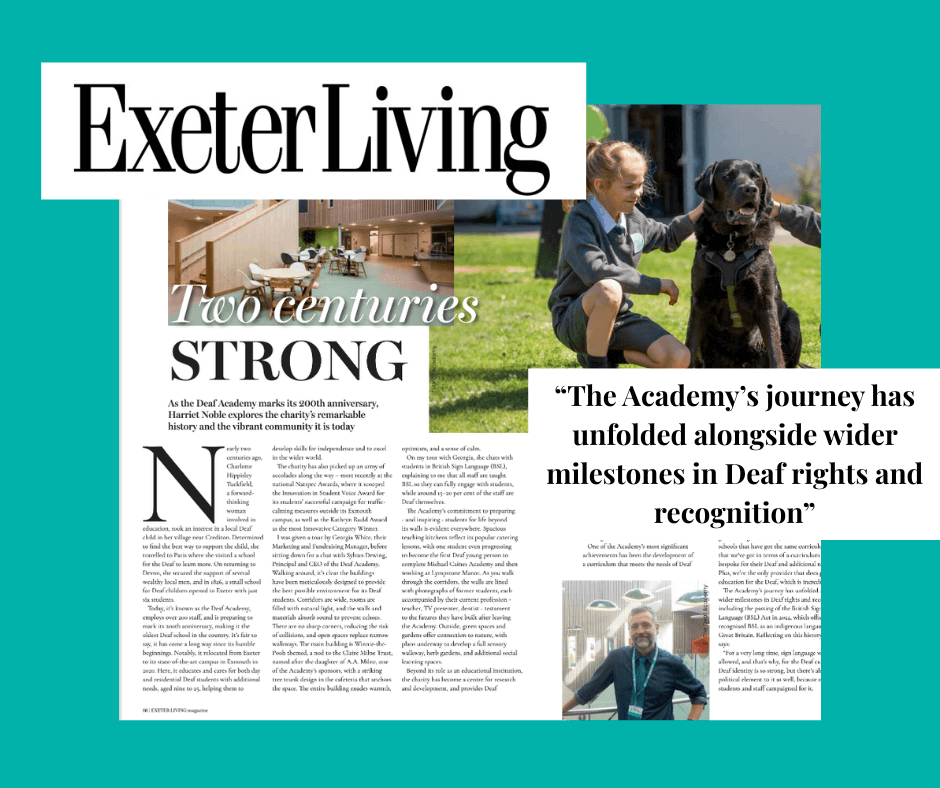
Exeter Living Magazine editor Harriet Noble recently visited the Deaf Academy and learnt about our charity’s “remarkable history” and “vibrant community” as we countdown to our 200th anniversary in 2026.
You can read the full article below.
Nearly two centuries ago, Charlotte Hippisley Tuckfield, a forward-thinking woman involved in education, took an interest in a local deaf child in her village near Crediton. Determined to find the best way to support the child, she travelled to Paris where she visited a school for the Deaf to learn more. On returning to Devon, she secured the support of several wealthy local men, and in 1826, a small school for Deaf children opened in Exeter with just six students.
Today, it’s known as The Deaf Academy, employs over 200 staff, and is preparing to mark its 200th anniversary, making it the oldest Deaf school in the country. It’s fair to say, it has come a long way since its humble beginnings. Notably, it relocated from Exeter to its state-of-the-art campus in Exmouth in 2020. Here, it educates and cares for both day and residential Deaf students with additional needs, aged nine to 25, helping them to develop skills for independence and to excel in the wider world.
The charity has also picked up an army of accolades along the way – most recently at the national Natspec Awards, where it scooped the Innovation in Student Voice Award for its students’ successful campaign for traffic-calming measures outside its Exmouth campus, as well as the Kathryn Rudd Award as the most Innovative Category Winner.
I was given a tour by Georgia White, their Marketing and Fundraising Manager, before sitting down for a chat with Sylvan Dewing, Principal and CEO of the Deaf Academy. Walking around, it’s clear the buildings have been meticulously designed to provide the best possible environment for its Deaf students. Corridors are wide, rooms are filled with natural light, and the walls and materials absorb sound to prevent echoes. There are no sharp corners, reducing the risk of collisions, and open spaces replace narrow walkways. The main building is Winnie-the-Pooh themed, a nod to the Claire Milne Trust, named after the daughter of A.A. Milne, one of the Academy’s sponsors, with a striking tree trunk design in the cafeteria that anchors the space. The entire building exudes warmth, optimism, and a sense of calm.
On my tour with Georgia, she chats with students in British Sign Language (BSL), explaining to me that all staff are taught BSL so they can fully engage with students, while around 15–20 per cent of the staff are Deaf themselves.
The Academy’s commitment to preparing – and inspiring – students for life beyond its walls is evident everywhere. Spacious teaching kitchens reflect its popular catering lessons, with one student even progressing to become the first Deaf young person to complete Michael Caines Academy and then working at Lympstone Manor. As you walk through the corridors, the walls are lined with photographs of former students, each accompanied by their current profession – teacher, TV presenter, dentist – testament to the futures they have built after leaving the Academy. Outside, green spaces and gardens offer connection to nature, with plans underway to develop a full sensory walkway, herb gardens, and additional social learning spaces.
Beyond its role as an educational institution, the charity has become a centre for research and development, and provides Deaf Awareness training to organisations including the Police, Met Office, RNLI, banks, and law firms, many of which have now integrated this training into their national frameworks.
One of the Academy’s most significant achievements has been the development of a curriculum that meets the needs of Deaf students with complex health profiles and additional needs, making it a sought-after provider across the country. “We’ve evolved from being not just regional but a national provider. The recent Natspec award recognition is amazing as it acknowledges the quality of our special needs education for college students nationally,” Sylvan says.
“Students come from all over the country now, because if you’re Deaf and autistic, or you’ve got learning difficulties, there aren’t other Deaf schools that have got the same curriculum that we’ve got in terms of a curriculum that is bespoke for students who are Deaf and additional needs. Plus, we’re the only provider that does post-19 education for the Deaf, which is incredible.”
The Academy’s journey has unfolded alongside wider milestones in Deaf rights and recognition, including the passing of the British Sign Language (BSL) Act in 2022, which officially recognised BSL as an indigenous language of Great Britain. Reflecting on this history, Sylvan says:
“For a very long time, sign language wasn’t allowed, and that’s why, for the Deaf culture, Deaf identity is so strong, but there’s also a political element to it as well, because our students and staff campaigned for it.
“For many of our young people coming here, it’s a school, it’s education, but it’s also their community, and it’s a celebration of cultural values and identity, because it is not just a linguistic community, it’s a cultural community. In days gone by, that wasn’t necessarily the case. Deaf education has been on a journey which also, in some ways, tells the story of The Deaf Academy.”
The Academy is planning a year of events aimed at celebrating its history and Deaf culture. A partnership with Exeter’s Northcott Theatre will bring deaf-led comedy nights, theatre performances, talks, workshops, and even a deaf rave to the city, along with a production by Deafinitely Theatre, the UK’s first deaf-led professional theatre company. For more information about the Bicentenary events click here.
You can see the digital article here, flick to pages 65 and 66